
 CASE STUDY · WEST TENTH · END-TO-END DESIGN PROCESS
Orchestrating End-to-End Design
User research, information architecture, wireframes, mockups, and prototypes that transformed a marketplace
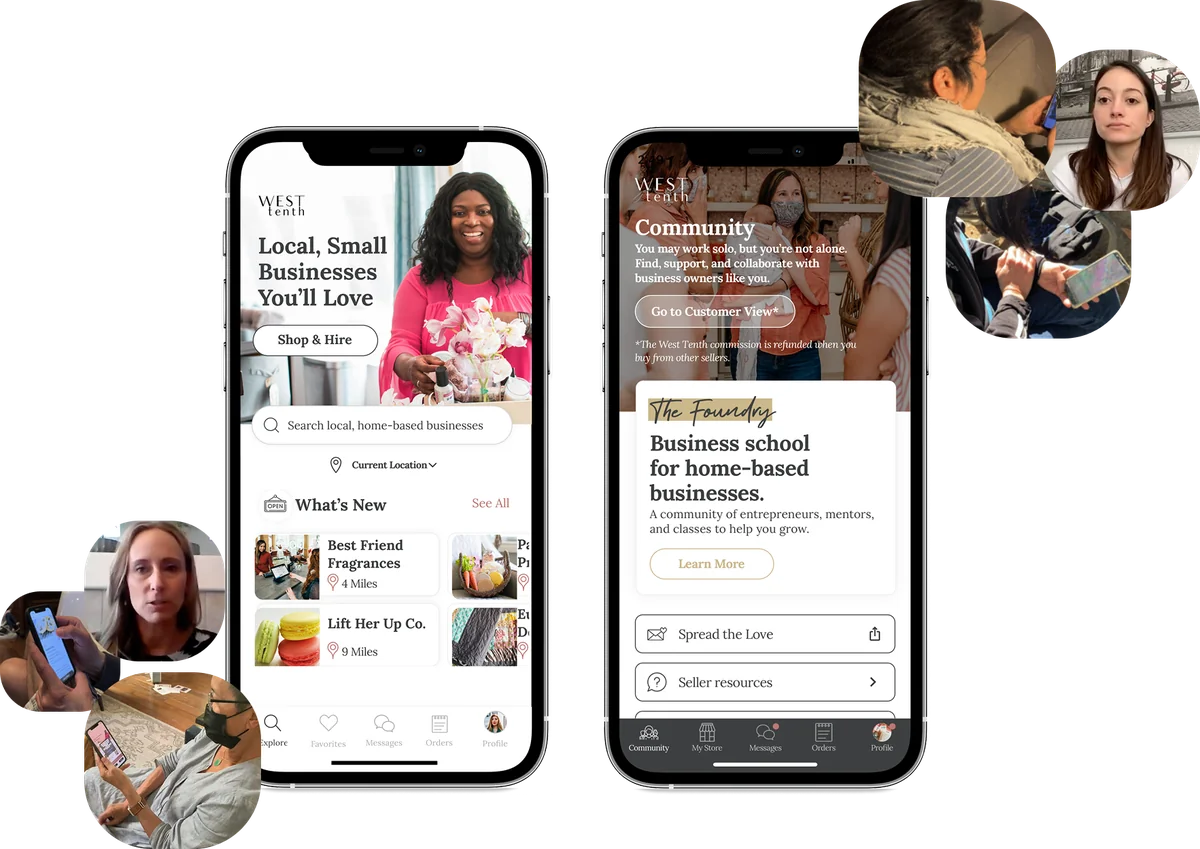
Most designers never see the full journey: research through launch through results. At West Tenth, an early-stage startup building a marketplace for women-owned, home-based businesses, I experienced this as Director of Product and Design, leading a complete mobile app redesign over 10 months in 2021. I owned the entire cycle — 40+ user interviews, Mixpanel analytics to identify drop-offs, user flows, wireframes, and prototypes tested with real users — while managing two designers and keeping engineering, marketing, and customer support aligned. Working in bi-weekly release cycles, we continuously refined based on data: buyer retention jumped 40%, sign-ups doubled, conversions doubled year-over-year, and sales grew 130%.

Situation
A Marketplace Searching for Product-Market Fit
West Tenth connected buyers and sellers, similar to Etsy. When I joined as one of the early hires, the mobile app had been in the market for less than a year. The problem was immediately clear: retention was low, new buyer onboarding didn't exist, and seller onboarding was confusing.
Task
What Do Buyers and Sellers Actually Need?
I owned both the design direction and the product roadmap, and I led the product team of designers, engineers, and QA. My first job was to find out why the app wasn't working, and that started with three questions:
Why weren't buyers coming back, and what would make them stay?
Where were sellers getting stuck during onboarding?
How should the mobile app and the new web app work together for both buyers and sellers?
Action
From 40 Interviews to Real Solutions
I started with research. I conducted interviews with both buyers and sellers — one conversation after another. In the first month alone, I did about 40 interviews. I partnered with our customer support team to understand what questions people were asking and what issues they ran into. I also looked at our analytics data from Mixpanel to see where people were dropping off in the flow.
Mapping, Prototyping & Testing
With all that information, I mapped out the user flows — how buyers and sellers actually moved through the app. This helped me and the two designers I was working with see all the places where the experience could be better. We explored different solutions, created wireframes, and built prototypes. We tested these ideas with real users and got feedback. Then we went back and made the designs better based on what we learned.
Cross-Functional Collaboration
Throughout this whole process, I stayed hands-on. I worked closely with our engineering team to make sure what I was designing was possible to build. I met regularly with marketing to understand what would help drive growth. I made sure the designers I was leading felt supported and knew why we were making the choices we were making.
Building the Notification System
One thing that really mattered was building the notification system from scratch. We designed it with one goal in mind: keeping users coming back. Instead of overwhelming them with too many messages at once, we prioritized what actually mattered — order updates, payment confirmations, and personalized thank-you notes. These notifications were stored in a dedicated Messages section so users could easily find them. The approach was simple but effective: send them valuable information that helps them understand what's happening on the platform, and they'll stay engaged. This focus on relevant, timely notifications made a real difference in how people used the app.
Outcomes
How We Turned It Around
Transformed the User Experience
We systematically rebuilt the critical parts of the app based on what users actually needed:
- Redesigned onboarding for both buyers and sellers
- Improved search and filtering
- Added a favorites feature
- Created useful notifications
- Launched Quick Shop for faster purchases
- Reimagined homepage discovery so buyers could find products they genuinely wanted
Every change came directly from user research and continuous feedback.
Delivered Significant Business Growth
The results validated the approach:
- Buyer retention jumped 40% within three months
- New buyer sign-ups doubled
- Store views converting to order requests doubled year-over-year
- Overall sales grew 130% year-on-year
These numbers proved that staying connected to user needs moves both the experience and the business forward.
Cross-Discipline Collaboration Drives Results
Great design doesn't happen in isolation — it comes from continuous iteration with your team and users, and from working hand-in-hand with engineers instead of just handing off designs. As both designer and product manager, I learned that clear goals, psychological safety for sharing ideas, and transparent communication were what enabled the team to move quickly and deliver real improvements. At a resource-constrained startup, that kind of teamwork is everything.
The Full Design Process, End to End
None of this was a single straight line. It was four phases — Discovery, Design, Build, and Measure & Results — cycling back into Design as each bi-weekly release surfaced new evidence from Mixpanel and user feedback. That loop, not a one-time launch, is what let the team keep improving the experience for ten straight months.
Feedback from the Team
Voices from West Tenth
-
Adriana knows how to organize chaos and build processes so that the products she works on develop smoothly. She is a researcher — she's looking for the optimal way to approach a UX problem, or is talking to customers, or keeping up with best practices. As our product director, Adriana helped us take a mobile app to the next level with users.
-
I had the pleasure of working on several projects, spanning varieties of scopes and complexity with Adriana leading the way. Working with Adriana is an exceptional experience! She has a unique way of pulling the best out of everyone on a team. She's constantly evolving her perspective on all aspects of business. Any team is lucky to have her at the helm.
-
It was a pleasure to work closely with Adriana. She helped facilitate efficient cross-department collaboration — keeping teams well informed, sharing ideas, and moving projects forward in an organized way. While listening to feedback and working to prioritize the needs of various teams into a strategic product roadmap, Adriana combined innovation, user insights, and metric-led ideas to inform product design for our mobile app and web app. Adriana would be an asset to any company.