
 CASE STUDY · AI SIDE PROJECT
Building AI-assisted design tooling
Turning open-ended exploration into a clear point of view on where AI fits in the design process
While at SAP working on AI agent workflows like the Bosch Autonomous Capitalization project and participating in company-wide AI spotlight events, I realized we were missing something: nobody truly understood where AI fits in the design process. This gap became the question I needed to answer. As a side project, I decided to explore this through the Design Thinking framework and built Relay, a tool that clarifies AI's role by positioning it as a partner that amplifies designers rather than replaces them.
Situation
AI Hype Without Direction
During my time at SAP's Intelligent Experience team, building AI agent workflows and exploring AI as a design tool, I noticed a critical gap: while everyone was enthusiastically prototyping, nobody had answered a fundamental question. In what part of the design process can AI actually create value? Will AI amplify designers or replace them?
Task
Map the Design Process and Find AI's Role
Rather than explore randomly, I chose a systematic approach: the Design Thinking framework. It's rigorous, widely understood, and cyclical — perfect for understanding where AI could genuinely help without replacing human judgment.
My question: at which stages does AI make designers faster, smarter, and more confident, while keeping them in control?
Action
From Framework to Working Tools
Mapping AI Onto Design Thinking
I mapped the complete Design Thinking process — Empathize, Define, Ideate, Prototype, Test, and Hand-off — and built a Figma diagram to visualize all six phases. For each phase, I identified the key tasks designers actually do, then mapped where AI could genuinely add value, and what role it should play: evaluate, plan, or generate.
From Diagram to Working Prototype
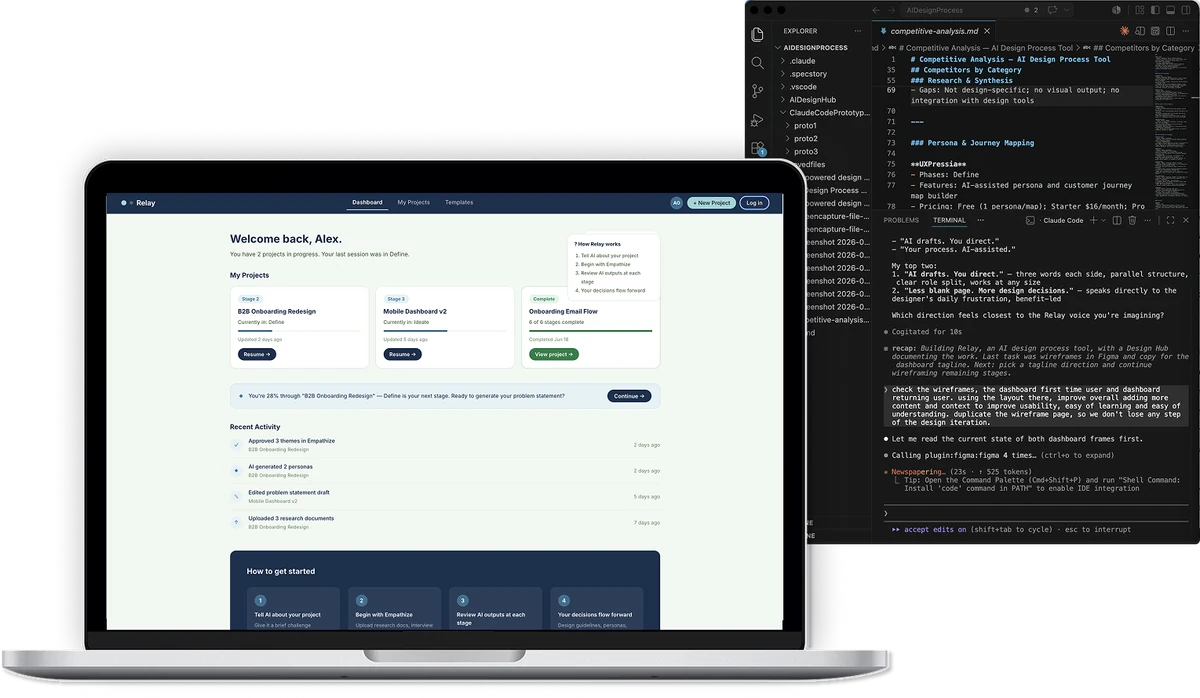
Using Figma's "Send to Figma Make" feature, the diagram became a functional prototype. But to build something more powerful, and to think through the design more deeply, I brought it into Claude Code. Using Figma's MCP integration, I moved between the two tools — designing in Figma, building in Claude Code, testing and refining — until Relay emerged: an AI-assisted design tool that guides designers through Design Thinking phases while keeping them in control.
Relay's dashboard gives designers a home base across projects — resuming a project mid-stage, seeing AI-generated activity at a glance, and getting oriented on how the tool works before diving in.
Documenting the Process: The Design Hub
As I built Relay, I created a Design Hub — documentation capturing my process at each phase, built and refined the same way, moving between Claude Code and the browser. It became a reference guide the team could use to understand the Design Thinking approach and apply it to future projects, making the process transparent and repeatable.
Outcomes
What AI Revealed About Design
AI Is a Multiplier: Control It, or It Controls You
AI makes fast things faster and hard things approachable, but it doesn't remove the need for judgment, taste, or deep thinking about the problem. The designer's job shifts from execution to direction: knowing what to ask, reviewing everything, and deciding what's actually good.
The challenge is that AI produces a lot of confident-sounding output. Left unchecked, it's easy to accept without scrutiny. What worked:
- Treat AI output as a starting point, not a conclusion.
- Give specific, narrow instructions.
- Ask for three bullet points, not a summary.
Control the output before it controls you. This is where Relay's real value emerged. It's not the tool itself that matters — it's what the tool revealed: AI amplifies human judgment, it doesn't replace it.
Design Leadership Remains About Understanding, Not Tools
Relay proved something important: great design doesn't come from better tools. It comes from understanding users so deeply that solutions feel inevitable. AI can help you work faster, generate more options, and document better, but it cannot do the hard thinking about what users actually need. As AI handles more execution work, design leadership becomes more strategic: judgment, empathy, and the ability to ask the right questions.