

Transforming Bosch's Plant Purchase with an Agentic AI Workflow
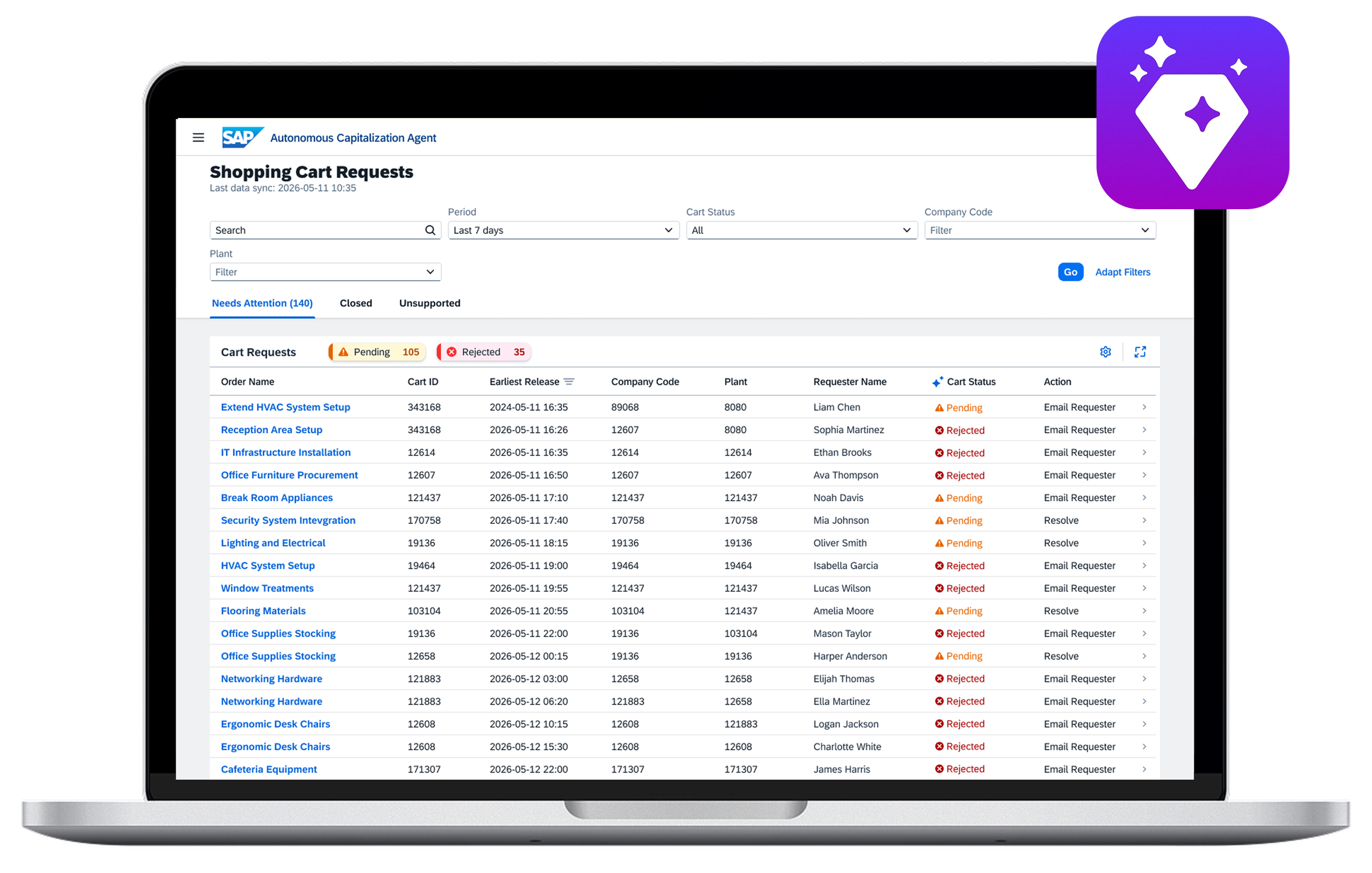

From day-one discovery through prototyping, I led end-to-end UX design for an AI agent that streamlines plant asset purchase approvals at Bosch — a global enterprise of 400,000+ employees — reducing manual validation, building trust in automated decisions, and laying the foundation for a scalable SAP product.
UX Design & Research | Agentic AI Experience | Enterprise SAP S/4HANA | Figma & Claude Code | 2026
Bosch revenue
€90.5B
300/day
manual checks → AI
in under 2 months
9 artifacts
A tailored AI solution for one of SAP’s most strategic customers
SAP's Forward Deployed Engineering program co-builds purpose-built AI solutions with strategic customers, then scales them into SAP's standard offerings. For Bosch — a global enterprise of 400,000+ employees — the project was an AI agent to streamline plant asset purchase approvals, reducing manual validation and building trust in automated decisions.
CHALLENGEA high-stakes accounting process buried in manual work
Bosch's accounting team reviews direct-capitalization purchase requests — purchases recorded as fixed assets like machinery, equipment, or tools. The approval process was entirely manual, creating significant friction at enterprise scale:
Approvers performed up to 15 checks per order across 20 orders per day — 300 manual validations daily — hunting for data across fragmented, disconnected systems.
Incomplete submissions from Requesters triggered rejection loops, causing rework and delays on both sides.
Inconsistent decisions resulted from the lack of a standardized, guided review process.
OBJECTIVESWhat this project set out to achieve
Reduce manual effort and approval delays for Bosch
Eliminate the time-consuming, error-prone process of manually cross-checking purchase requests across disconnected systems — giving accounting teams a faster, more consistent path from order submission to approval.
Prove the value of agentic AI in a live enterprise environment
Demonstrate that an AI agent can take on complex, multi-step accounting validation tasks reliably — building the evidence base and UX patterns needed for SAP to bring this capability to a broader set of customers.
Establish a repeatable FDE design model for SAP’s AI portfolio
Shape a UX approach — from discovery and flow design to Fiori-compliant mockups and coded prototypes — that can be refined and scaled into SAP’s standard AI product offerings, beyond this single customer engagement.
MY PROCESSFull Lifecycle Design
I led discovery, definition, and design from the start — showing up in daily client meetings to gather knowledge, validate assumptions, and present work in progress. Here is the full arc of what I produced.
Starting Discovery
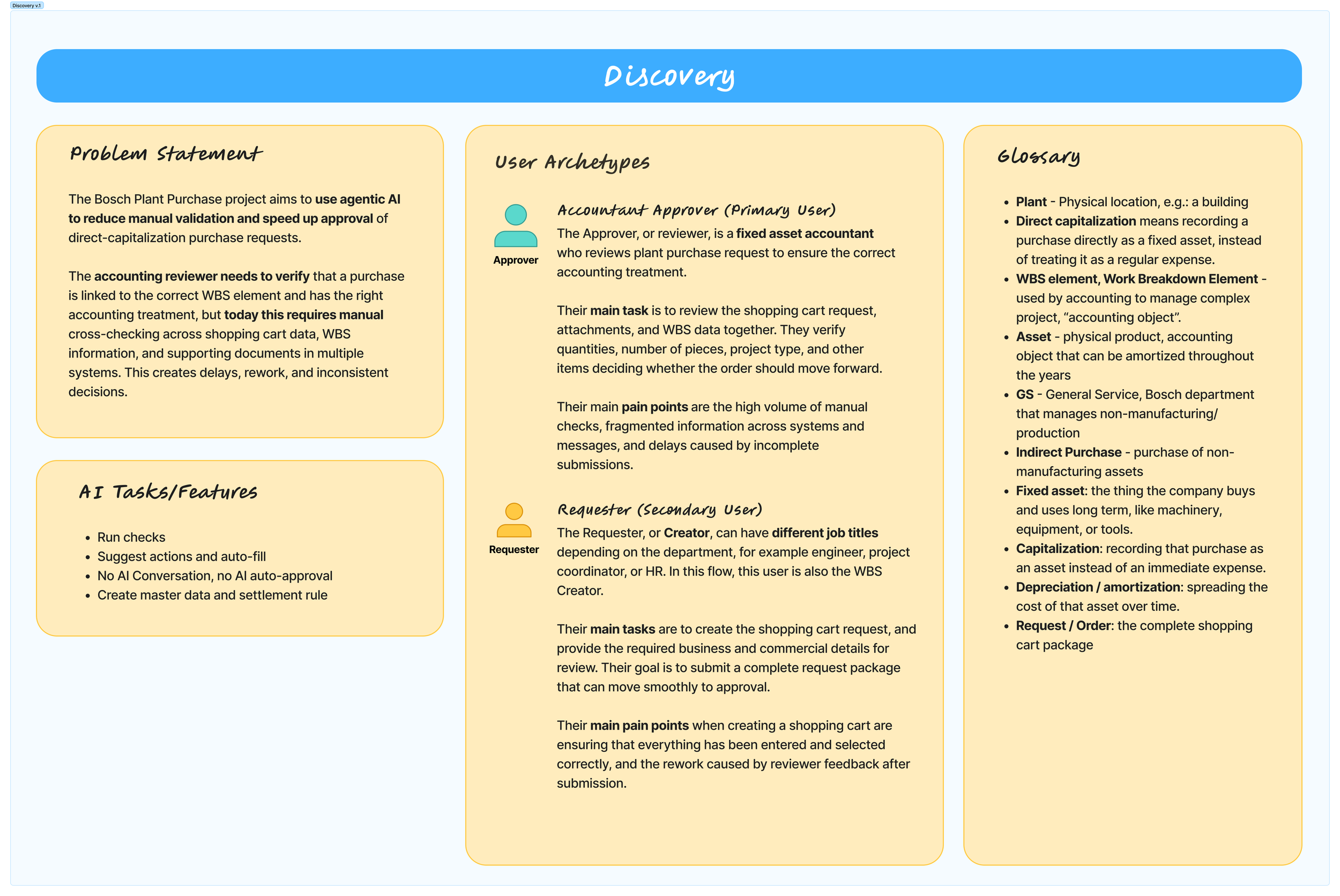
I started by mapping how the current process actually worked — across SAP S/4 Project Builder, Bosch Shopping Cart, email, and manual checks — making the friction visible and giving the team a shared baseline.
Existing flow audit — mapped the as-is process across all tools and touchpoints to surface friction and align the team around a shared baseline.
Problem statement — defined the core challenge: manual cross-checking across disconnected systems was creating delays, rework, and inconsistent decisions for accounting reviewers.
Personas — built two user archetypes from daily conversations with the Bosch team: the Accountant Approver (primary) and the Requester (secondary), each with goals, tasks, and pain points.
Glossary — documented the client's domain language — terms like WBS element, direct capitalization, settlement rule, and fixed asset — ensuring the entire team, from design to engineering, spoke the same language as the users throughout the project.
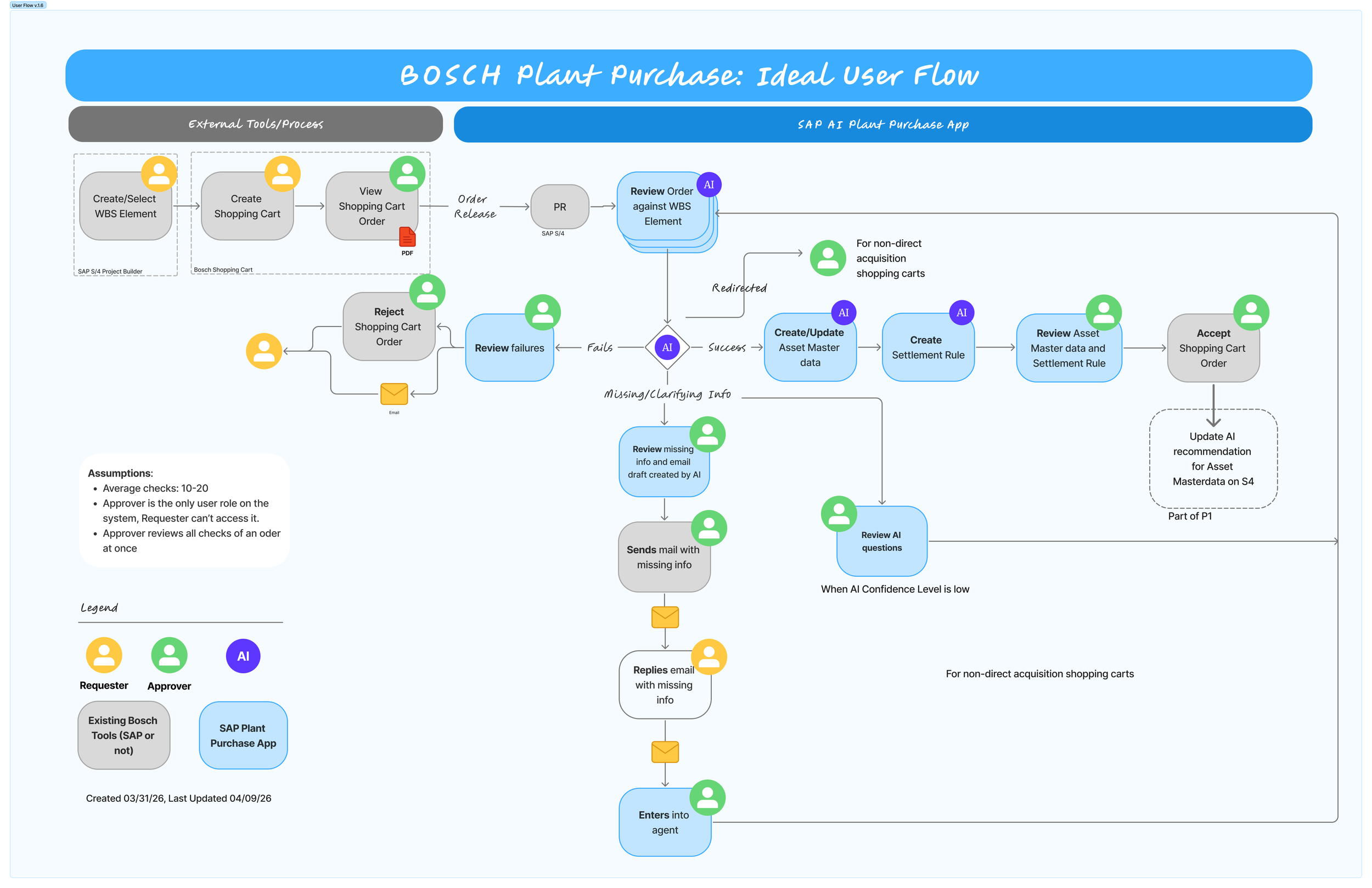
Proposed user flow
I mapped the ideal end-to-end flow for the SAP AI Plant Purchase App — spanning external tools, the new application, and the email loop for missing information. The flow defines precisely where the AI acts autonomously, where it surfaces recommendations for human review, and where it escalates. Crucially: no AI auto-approval, ever.
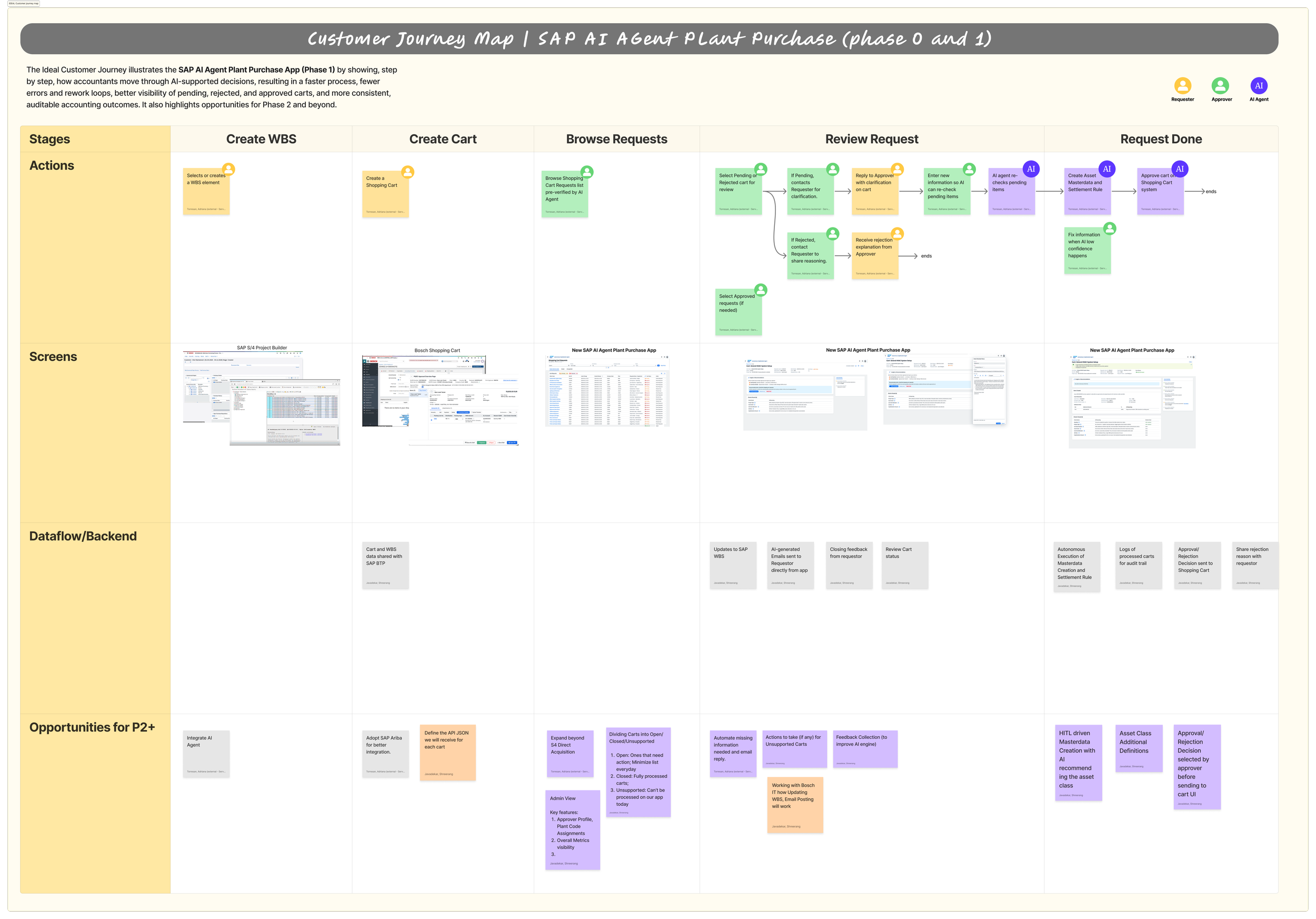
Customer journey map
I charted the Approver’s experience across the full purchase lifecycle — their actions, thoughts, emotional state, and pain points at each stage. This gave the engineering team visibility into where cognitive burden was highest and where the AI could deliver the most relief.
OOUX model
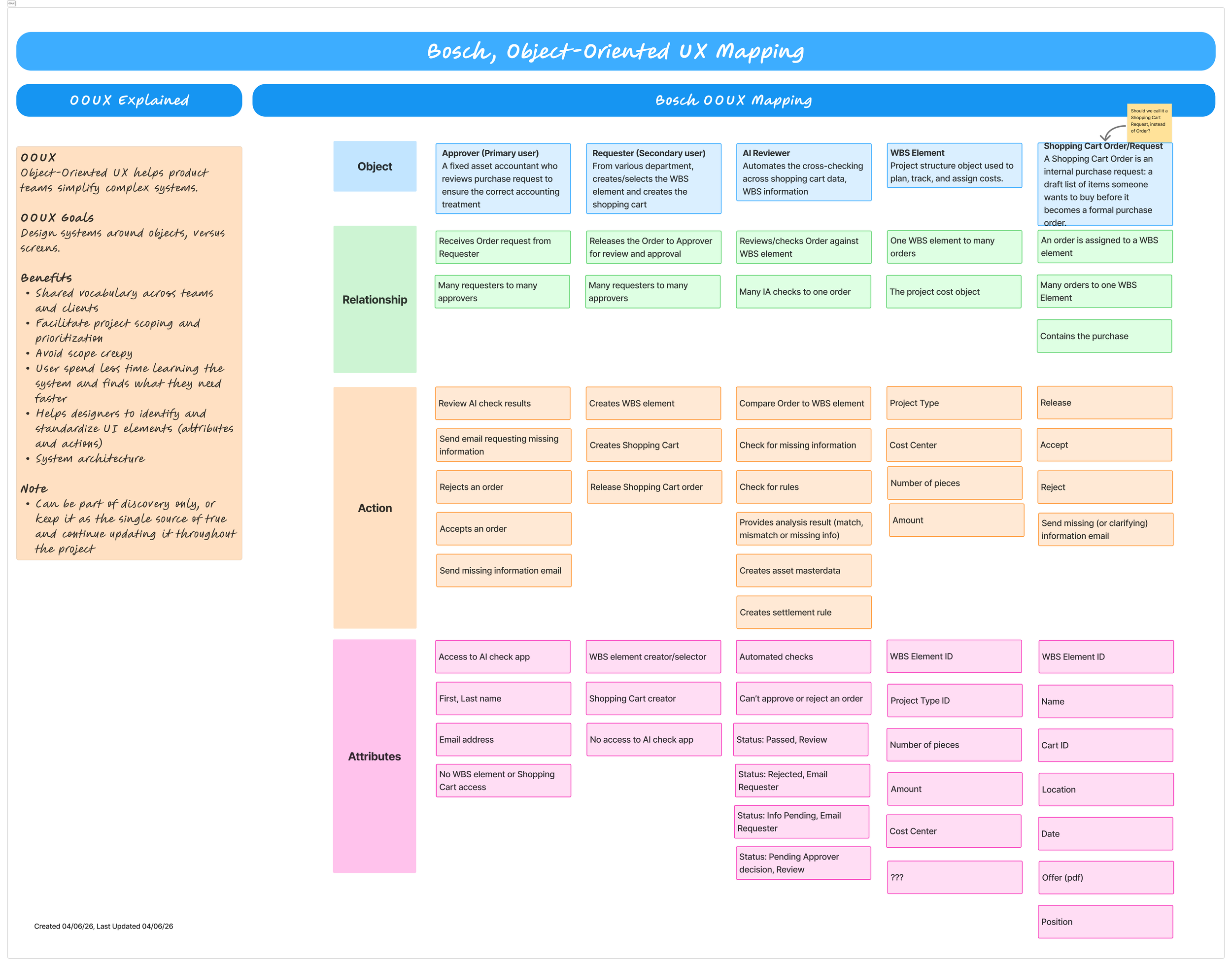
I applied Object-Oriented UX to define the core objects in the system — orders, WBS elements, assets, settlement rules — along with their attributes, actions, and relationships. This gave the design a structural backbone and helped engineering align the data model to the user’s mental model.
Mockups & Prototype
I designed high-fidelity screens in Figma with SAP Fiori compliance top of mind — always thinking about content hierarchy and making the experience easy to scan, understand, and act on. Every screen was reviewed with the client team in daily syncs and iterated based on their feedback. Using Claude Code and Figma Make, I then rapidly built a functional prototype to bring the agentic flow to life — making it tangible for stakeholders, demonstrating how human and AI actions interplay in practice, and surfacing edge cases earlier than a static mockup could.
DESIGN DECISIONSDesigning for trust in an agentic system
The hardest design challenge wasn’t the UI — it was defining the right relationship between human judgment and machine action. These were the principles I held throughout.
Human oversight at every branch
No AI auto-approval. The agent acts, but a human reviews before any consequential data is committed. Accountability is always traceable.
Fiori compliance as a foundation
I designed within SAP’s Fiori Design System throughout, ensuring the experience felt native, accessible, and scalable into SAP’s broader product suite.
Reduce, don’t replace, human judgment
The agent handles high-volume mechanical checks. Humans focus on judgment calls: does this order make business sense?
Confidence as a design signal
Low AI confidence triggers a distinct interaction path — not a failure state. Designing for uncertainty reduced cognitive burden for Approvers.
Domain language as design material
I learned the accounting vocabulary deeply — WBS elements, settlement rules, capitalization — and used it precisely in every label, message, and AI output.
Validate with real users:
I proactively pushed to run user testing sessions with actual Bosch Approvers — to validate assumptions, surface usability issues, and improve the experience before it went live.
OUTCOMESA Vibe Code Prototype Delivered. A System Ready to Scale.
The UX design phase was completed in full — from discovery and flow design through mockups and a functional prototype. The project was paused due to client-side engineering resource constraints, with the design work ready to resume and implement.
Key contributions delivered:
Designed an agentic workflow to automate 15 checks per order across 20 orders per day — replacing up to 300 manual validations daily with AI-driven processing.
Defined the human-oversight framework at every AI decision point, establishing the trust and accountability model for enterprise adoption.
Delivered a functional vibe-coded prototype using Claude Code, making the agentic flow tangible for stakeholders and ready for engineering handoff.
Produced nine UX artifacts — from audit and personas through mockups and content design — positioned to scale into SAP's standard AI product offerings.
LESSONS LEARNEDIn Agentic AI, Every Word Is a Design Decision
Content design is even more critical in AI experiences.
When an AI agent is making decisions, surfacing results, and drafting communications on a user's behalf, every word carries more weight. Labels, confidence signals, error states, and AI-generated email drafts all need to be precise, trustworthy, and written in the user's own vocabulary. On this project, getting the language right — using terms like WBS elements, settlement rules, and direct capitalization fluently — was as important as the interaction design itself. In agentic AI, content design isn't a finishing step; it's a core design material.
Use AI in the design process thoughtfully, not just quickly.
AI tools can accelerate the design process — but only if you stay in control of the output. AI has a tendency to over-generate: producing more than you asked for and filling gaps with plausible-sounding content that still needs careful review. The risk is that speed becomes an illusion. The right approach is to use AI for drafts and exploration, then apply sharp editorial judgment to everything it produces. AI speeds up the process when you treat it as a starting point, not a final answer.
As of June 2026, one area where AI still falls short: diagrams and flows. The logic breaks down, relationships get misrepresented, and the output requires so much correction that it's often faster to build from scratch. For visual systems thinking, we can get the diagram structure on AI, but manual craft is still the better path.